


STOP TRYING TO FEEL SOMETHING
- Jeffrey Dreisbach

- May 28
- 5 min read
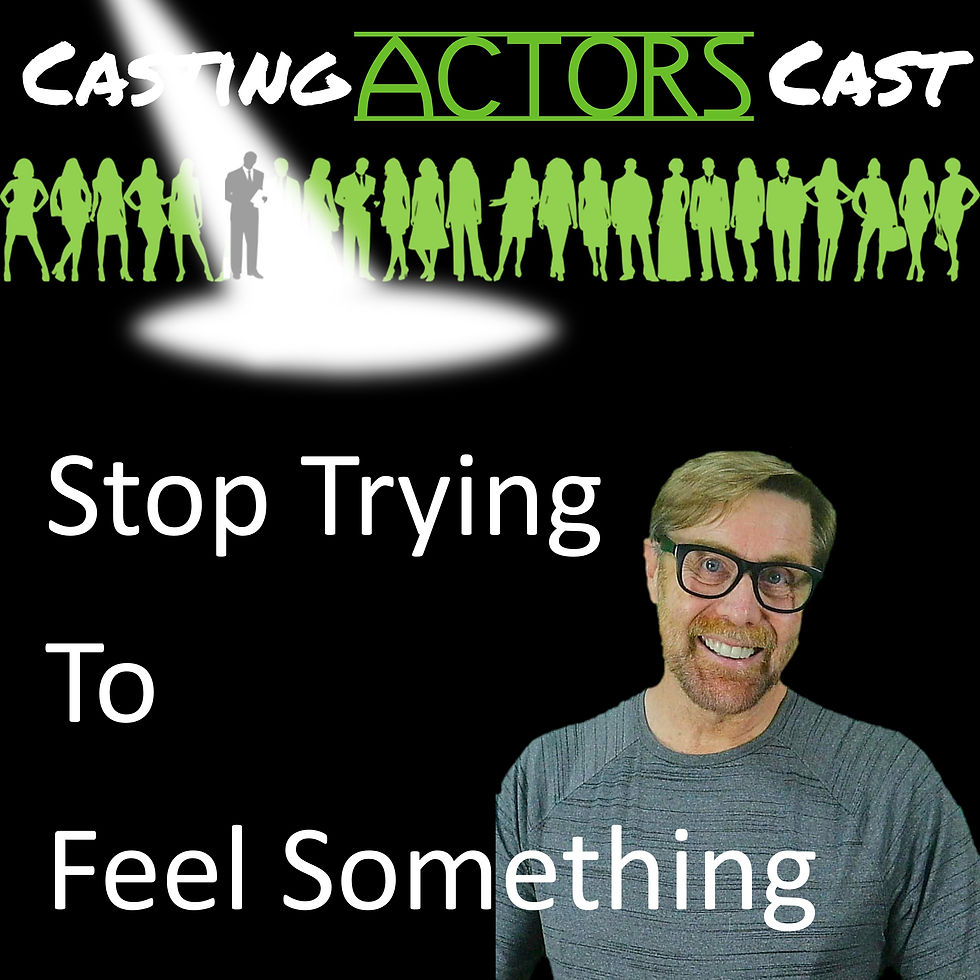
What if your obsession with “feeling the emotion”… is actually hurting your acting?
Today we’re talking about the difference between feeling something… and doing something.
And trust me— this one tends to make actors very uncomfortable.
INTRODUCTION
Hello everyone and welcome back to Casting Actors Cast!
Jeffrey Dreisbach here.
And today we are diving into one of the biggest acting traps I see constantly.
Actors trying desperately to FEEL.
Now listen. Emotion matters. Of course it does.
But actors sometimes approach emotion like it’s a hostage negotiation.
“Come on sadness… please arrive before take three.”
And when the feeling doesn’t magically appear? Panic.
Then we get: • pushing • forcing • emotional strain • fake intensity
Which ironically creates LESS truthful acting.
So today I want to discuss a major shift.
Stop trying to feel something. Start doing something.
SEGMENT 1 — FEELINGS ARE UNRELIABLE
Here’s the issue.
Human beings do not consistently control emotion.
If we did… none of us would eat cake at midnight while watching documentaries about failed amusement parks.
Emotion is unpredictable.
But behavior? Behavior is playable.
You may not instantly feel heartbreak.
But you CAN: • plead • attack • avoid • seduce • pressure • joke • withdraw • guilt • comfort
Those are actions.
And actions create life.
SEGMENT 2 — THE PROBLEM WITH EMOTION-FIRST ACTING
Emotion-first acting often becomes self-focused.
The actor begins monitoring themselves:
“Am I emotional enough?” “Do I feel it?” “Did that look real?”
The performance turns inward.
But great acting usually moves outward.
Toward another person.
That’s where energy lives.
REALITY CHECK
Real casting room truth:
The actors who try hardest to show emotion… are often the least believable.
Why?
Because audiences don’t connect to emotional display.
They connect to recognizable human behavior.
Someone trying to hold themselves together? Interesting.
Someone trying desperately NOT to cry? Interesting.
Someone attempting to stay charming while falling apart internally? Very interesting.
That tension creates watchable behavior.
SEGMENT 3 — NEED CREATES ACTION
This idea has become central to how I teach.
Instead of: “What emotion am I playing?”
Ask: “What do I NEED from the other person?”
Because once the need becomes clear… action appears naturally.
For example:
If I desperately need: • forgiveness • reassurance • validation • connection • approval
I automatically begin behaving.
Now we’re alive.
Now we’re not “performing emotion.”
We’re pursuing something.
And here’s the strange thing…
The audience almost never remembers the emotion.
They remember the NEED.
Think about the performances that stay with you.
It’s rarely :“Oh wow…that actor looked sad.”
No.
It’s: “They needed that person to love them. "“They were trying not to fall apart.” “They needed one more chance.” “They needed to be heard.” “They needed dignity.” “They needed someone to stay.”
That’s what we connect to.
Because human beings are always pursuing something emotionally underneath the conversation.
Always.
Even in silence.
Especially in silence.
And actors sometimes forget this because acting classes can accidentally train people to become emotional illustrators.
You know what I mean.
The actor is “showing us” upset. Showing us intensity. Showing us trauma. Showing us pain.
But real people? They usually try to HIDE what they feel.
That’s why behavior becomes fascinating.
A person trying not to cry…is more compelling than someone announcing sadness.
A person fighting to stay composed? That’s riveting on camera.
Because now the camera is capturing conflict.
And conflict creates watchability.
Here’s a great audition example.
An actor gets a scene where their romantic partner is leaving them.
Immediately the actor thinks: “Okay… this is emotional.”
But a stronger actor asks: “What do I NEED?”
And suddenly the scene changes.
Maybe the need is :“Please don’t leave me alone. ”Or: “Tell me I mattered. ”Or: “Give me one reason not to hate myself.”
Now the actor isn’t playing “sad.”
They’re fighting for survival emotionally.
That changes EVERYTHING.
Now pauses happen naturally.Listening becomes active.Behavior becomes unpredictable.The performance breathes.
Because real behavior is never perfectly planned.
And here’s another thing casting notices immediately:
Actors trying to “feel” often stop listening.
Why?
Because they’re internally monitoring themselves.
They’re checking:“Am I emotional enough?”“Am I connected enough?”“Is this moment working?”
Meanwhile…the scene partner just changed the entire emotional dynamic —and the actor missed it completely because they were busy watching themselves perform.
That’s a huge shift.
The best actors are not self-watching.
They’re engaged.
They’re affected.
They’re responsive.
And honestly?Some of the best auditions I’ve ever seen were NOT highly emotional.
They were deeply NEEDFUL.
There’s a difference.
Need creates urgency.
Need creates behavior.
Need creates unpredictability.
And unpredictability feels human.
That’s why some actors can whisper and still break your heart.
Because truth does not equal volume.
Truth equals investment.
And this becomes incredibly important in self-tapes.
Because the camera is brutally honest.
It sees tension.It sees pushing.It sees anticipation.
But it also sees thought.
It sees longing.
It sees someone trying desperately to hold themselves together.
That’s compelling.
So the next time you’re preparing a scene…stop asking:
“What emotion should I play?”
Instead ask:
“What am I afraid will happen if I DON’T get what I need?”
Now suddenly the stakes become personal.
Now behavior activates.
Now the acting becomes alive.
And here’s the beautiful part:
Once the need is real…emotion often arrives on its own.
Unexpectedly.
Naturally.
Sometimes not at all.
And that’s okay.
Because truthful acting is not emotional demonstration.
It’s human pursuit.
SEGMENT 4 — PLAYABLE HUMAN BEHAVIOR
Actors sometimes use emotional adjectives that are impossible to play.
“Be emotional.”
Okay… what does that even mean?
But: “Try to stop them from leaving.”
THAT is playable.
Now we have: • urgency • tactics • adjustment • listening • reaction
Behavior becomes dynamic.
And honestly? It also removes enormous pressure from actors.
You stop chasing emotional perfection.
You start engaging another human being.
SEGMENT 5 — THE DANGER OF INDICATING
One of the most common actor habits is indicating.
Showing us the emotion.
Presenting sadness. Demonstrating anger. Advertising fear.
But real human beings usually try NOT to reveal themselves.
That’s where complexity lives.
The strongest acting often happens when: • the behavior and emotion conflict • the person is trying to hide something • the need leaks out accidentally
That’s gold.
QUICK EXERCISE
Take a dramatic scene.
Now remove all emotional intention.
Instead: Choose ONE clear action.
Examples: • convince them • calm them • trap them • comfort them • make them stay
Play ONLY the action.
Notice how emotion begins emerging naturally.
That’s the difference.
CONCLUSION
Actors often believe emotion creates action.
But many times… action creates emotion.
And when actors stop trying to manufacture feelings… the work often becomes more truthful.
More spontaneous. More human.
Thank you so much for joining me.
I’m Jeffrey Dreisbach. This is Casting Actors Cast.
Keep working. Keep exploring. And stop trying to cry on cue in aisle seven of your acting class.
Your work deserves better than that.
See you next time.


Comments